
Last updated: September 4, 2026
If you own a boat that pulls in seawater, you already rely on a raw water strainer. Whether you think the strainer or not, it’s a vital part of the boat that quietly does its job…until it doesn’t. Then you’re dealing with overheating engines, clogged AC, hot boats, and ruined weekends.
This guide breaks down what a raw water strainer is, how it works, and the different types of boat strainers you’ll see on real-world setups.
What is a raw water strainer?
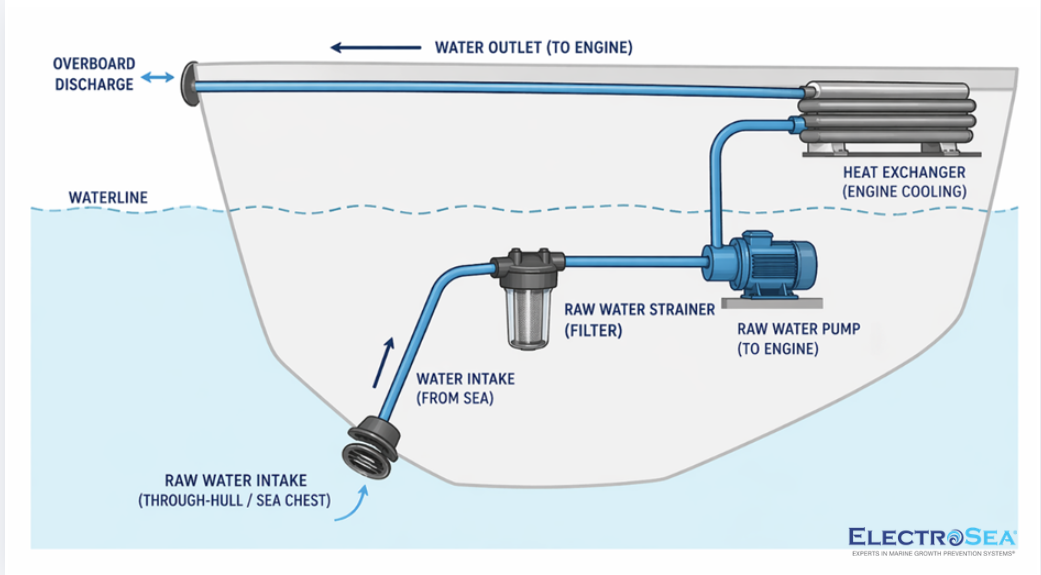
A raw water strainer is a simple filter that sits in your boat’s water intake line. The strainer’s job is to catch debris like seaweed, shells, sand, and even marine life like seahorses or jellyfish, before that water reaches your boat’s systems.
Also referred to as sea strainers, boat strainers, marine strainers, and a slew of similar names, these strainers all accomplish the same thing.
The raw water strainer delivers raw seawater from the ocean to:
- Air conditioning systems
- Engines (1-5 engines common on center consoles and motor yachts)
- Generators (onboard power units)
- Livewells and washdowns (live bait/fish tanks and deck rinse systems)
Without a strainer, all that debris would go straight into pumps, hoses, and cooling systems, causing major damage.
If seaweed or a plastic bag clogs your engine’s raw water intake, the engine can overheat—warping parts and causing serious damage.
>> ElectroStrainer uses award-winning technology to prevent marine growth directly inside your strainer. No chemicals. No marine growth. No descaling. Trusted by over 100 boat OEMS and dealers around the world and thousands of boat owners. Get my free quote today.
How a raw water strainer works
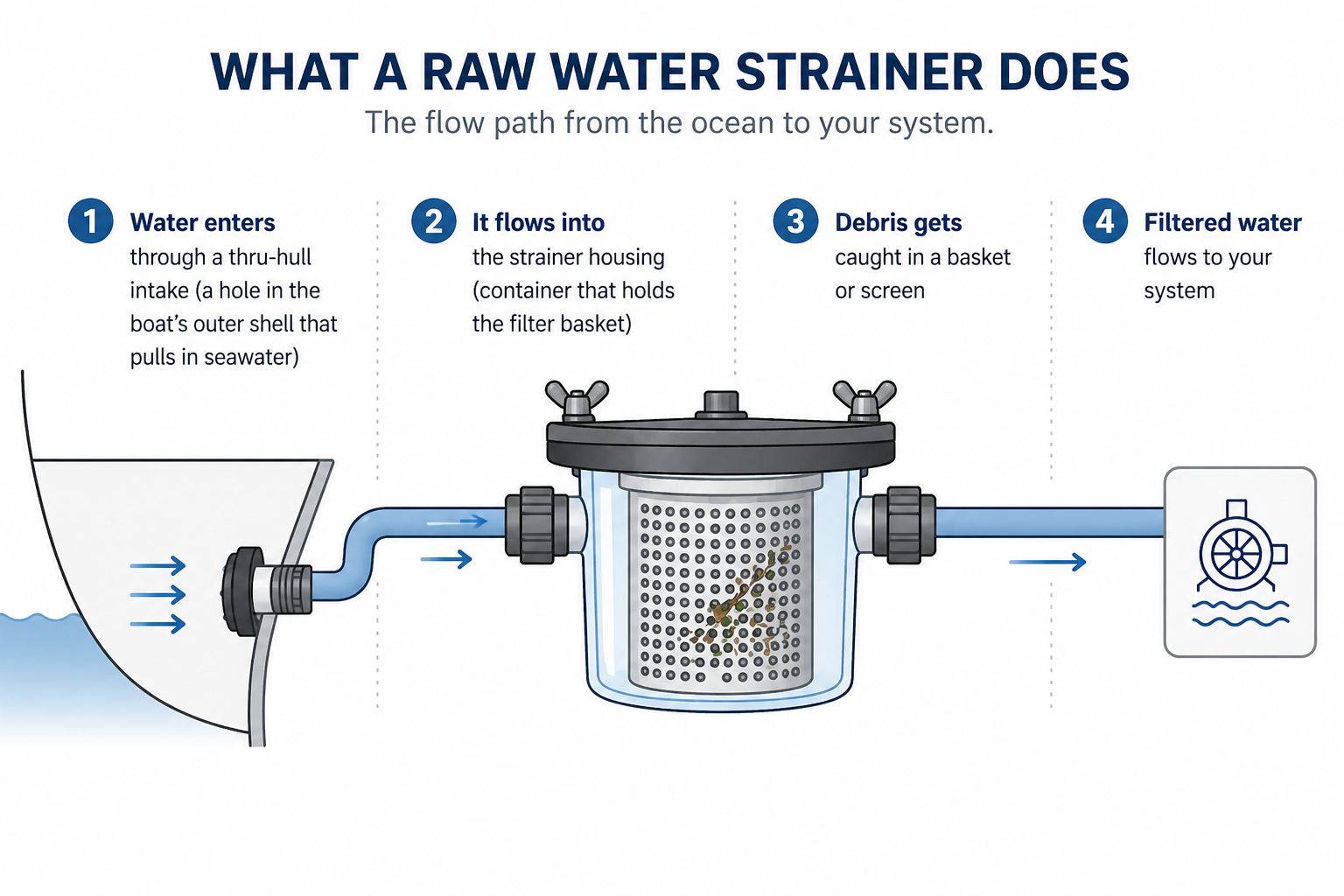
At a basic level, it’s straightforward:
- Water enters through a thru-hull intake (a hole in the boat’s outer shell that pulls in seawater)
- It flows into the strainer housing (container that holds the filter basket)
- Debris gets caught in a basket or screen
- Filtered water flows to your system
Most strainers use a clear housing (outer casing), so you can see when it’s getting clogged. When the basket fills up, the water flow drops and that’s when you start noticing issues.
Why sea strainers are mission-critical on boats
A lot of boat owners treat strainers like checkbox items, like deck cushions or boat linens. Buy it, check on it occasionally, move on.
The reality is:
- Flow is everything. Your boat’s most vital parts – AC, engine, and pumps – depend on steady water flow
- Clogs are abrupt and sudden. Water flow can go from fine to blocked overnight.
- Marine growth loves strainer baskets. In warm, nutrient-rich water (like Florida), barnacles and other sea growth build up fast.
That’s why strainers often become a maintenance headache, not a one-time solution.
3 Common types of raw water boat strainers
Newcomers to boating are often surprised to learn how many strainers a boat may have. A center console, sportfisher, or other seawater yacht could have anywhere from 5 to 8 different strainers on board.
Boats require multiple strainers and different types of strainers for different types of jobs. Here’s a breakdown of three common types.
1. External intake strainers (scoop strainers)
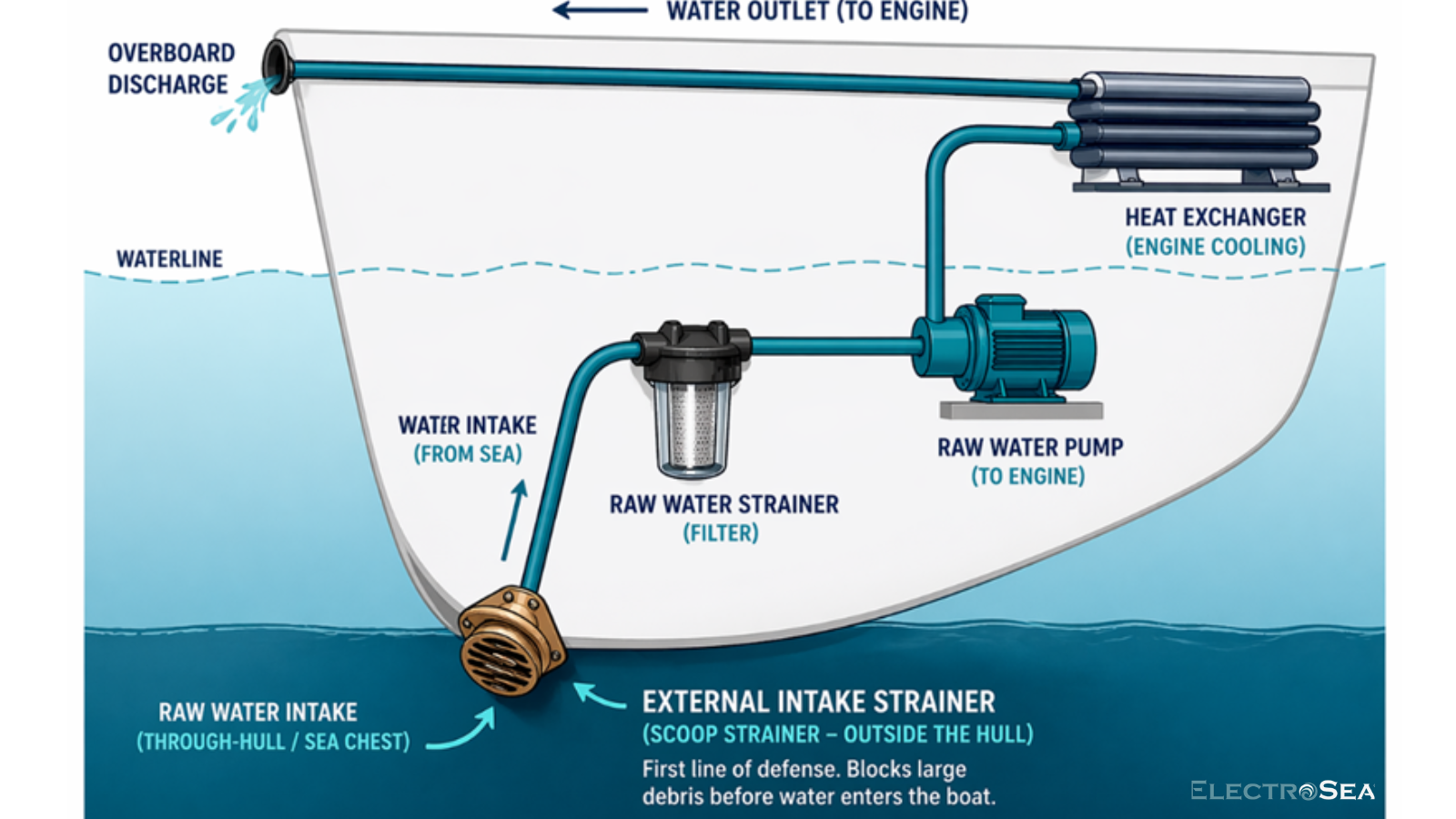
These sit outside the hull, over the thru-hull opening.
What marine strainers do:
- Block large debris before it even enters the boat
Pros:
- First line of defense
- Reduce big blockages
Cons:
- Can still clog from growth
- Harder to inspect and clean
- Doesn’t stop smaller debris or buildup inside the system
2. Inline basket strainers (the “classic” raw water strainer)
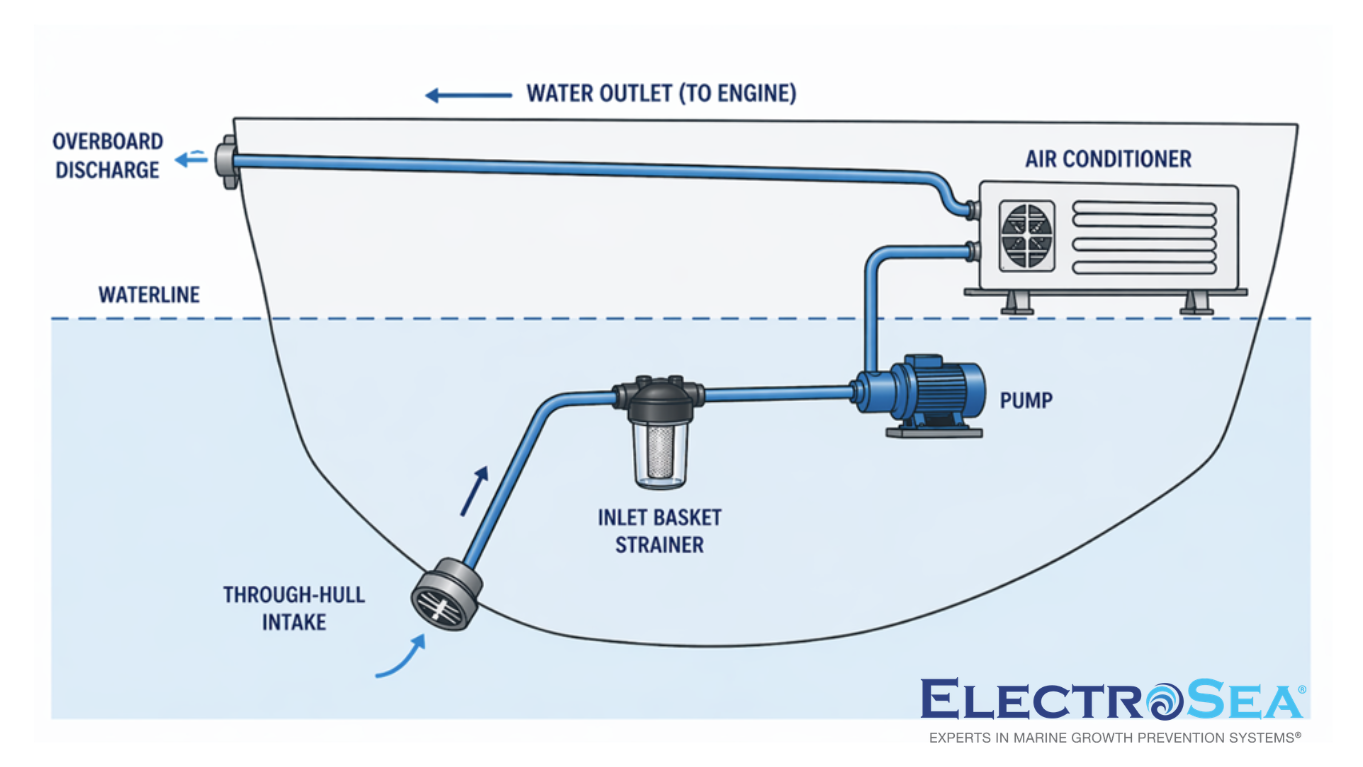
This is what most people think of: a clear canister with a removable basket inside. The strainer sits inline – in the middle of the water intake, not off to the side – to catch debris in a removable basket that’s commonly made of bronze, stainless steel, or plastic.
What inlet basket strainers do:
- Catch debris inside the boat before it reaches the pumps or AC
Pros:
- Many are easy to install (fit directly in the intake line)
- Widely used and understood
- Small profile; takes up minimal space
Cons:
- Smaller capacity; clogs faster with debris
- Requires regular cleaning
- Magnet for marine growth (especially barnacles) in warm sea waters like Florida
- Flow drops as the basket fills up
This is where a lot of strainer-cleaning headaches (usually nightmares) come from. Raw water strainers are often installed low in tight engine spaces, so accessing them means awkward positioning and limited visibility.
And since it sits at the intake line, you must shut off water and open a water-filled housing to reach the strainer, making it messy and time-consuming.
Next, debris removal. Barnacles and slimy growth don’t just fall out when you pull out the strainer. Often, you have to pick, rinse, or scrub it off by hand – commonly in a cramped, hot messy space.
For boaters who clean their strainer once or twice a year, many don’t mind the chore.
But for boaters in warm-weather areas like Florida, Texas, and Louisiana, cleaning strainers has been described as “boating hell.” In these regions, raw water strainers often require weekly maintenance.
You could run your boat without AC in extreme heat; however, probably not if you want to be a passenger aboard. Interior cabins quickly become stifling (well over 100°F). Prolonged heat and humidity can warp wood and cause mold growth on upholstery, life jackets, walls, and ceilings (headliners).
3. Sea chest systems
A sea chest is more common on larger, more complex boats like commercial vessels (fishing boats, workboats, ferries), large sportfish boats, large motor yachts, and super yachts.
While smaller boats may rely on several marine strainers connected to individual thru-hull intakes (holes in the boat’s outer shell), a sea chest pulls water into a central “box” that feeds multiple systems.
Small commercial workboats and mid-size motor yachts may typically use only one sea chest, but larger vessels may have multiple sea chests. Splitting up the workload (i.e., engines vs. A/C) can improve reliability and offer backup protection if one gets clogged.
What sea chests do:
- Consolidates water intake for engines, AC, and other boat systems
Pros:
- Fewer thru-hulls for a cleaner hull with fewer failure points
- Better flow at speed (less air ingestion)
- Centralized intake; cleaner layout
- Grates or screens can stop large debris early
Cons:
- If there is a clog or failure, multiple systems are impacted at once
- More complex installation and plumbing
- Harder to inspect than a clear, inline strainer
- Requires periodic maintenance to address biofouling, sediment, and marine growth
- Cleaning complexity; requires special tools since it’s a hull-mounted chamber
Signs your strainer setup isn’t (or is) working
When people think about their sea strainer setup, they’re usually thinking about their A/C strainer (inlet basket raw water strainer).
Why? This strainer can be the most tedious to care for and maintain. And it’s obvious when your air con strainer is failing.
Signs your sea strainer isn’t working
If you’re seeing any of these signs, your seawater strainer may be clogged, failing, or nearing the end of its life.
- Boat air conditioning loses performance over time.
- You’re cleaning your strainer more than you want to admit.
- You’ve had to flush your system to remove buildup.
- Water flow measures or seems weaker.
- Pumps or impellers wear out faster than expected.
These are clues that something is happening beyond what your current boat strainer can handle.
Signs you want – so you know your raw water strainer is working
With seawater strainers often in hard-to-reach places, it’s not always easy to physically inspect your marine strainer and know it’s working.
Without visual inspection, there are clues that your sea strainer is unclogged and performing well:
- Boat air conditioning performance is strong and steady.
- Your strainer needs minimal cleaning.
- Strong, steady stream of water discharging.
- Pump sounds smooth (no straining or cavitation noises).
- No high-pressure or “low flow” alarms.
These are indications that your raw water strainer is in solid condition and performing well – if you keep it clean.
For some strainer designs, maintenance is minimal. With an ElectroStrainer, it’s nearly nonexistent. Most owners simply give it a quick rinse every few months, usually when they notice a drop in flow. Because it uses electrochlorination (converting saltwater into a small, controlled amount of chlorine), marine growth can’t take hold. That means no soaking, no scrubbing, and no descaling.
>> Learn more about the award-winning ElectroStrainer. No strainer growth, no failed A/C systems, no hot boats and ruined trips. Get my quote now..
Yet for other raw water strainers, like Groco or Perko, cleaning is a manual process for removing barnacles and debris. Boaters commonly soak strainers in vinegar or muriatic acid and scrape (file) off stubborn buildup. Products like Barnacle Buster are also used, although the acid content wears components, degrading rubber hoses, seals, gaskets, and pump impellers.
Conclusion
At its core, a raw water strainer is just a filter. Boat strainers keep debris and marine growth out of the water feeding your boat’s critical systems. Without it, water clogs lines, restricts flow, and damages components that rely on steady cooling.
What surprises most owners isn’t what a strainer does — it’s what it takes to keep it working. As buildup accumulates, flow drops, systems run hotter, and maintenance escalates from quick cleanouts to acid descaling, premature pump wear, and, eventually, expensive failures like a chiller going down. However your system is set up, it comes down to this: if water can’t move freely, nothing else works the way it should.