
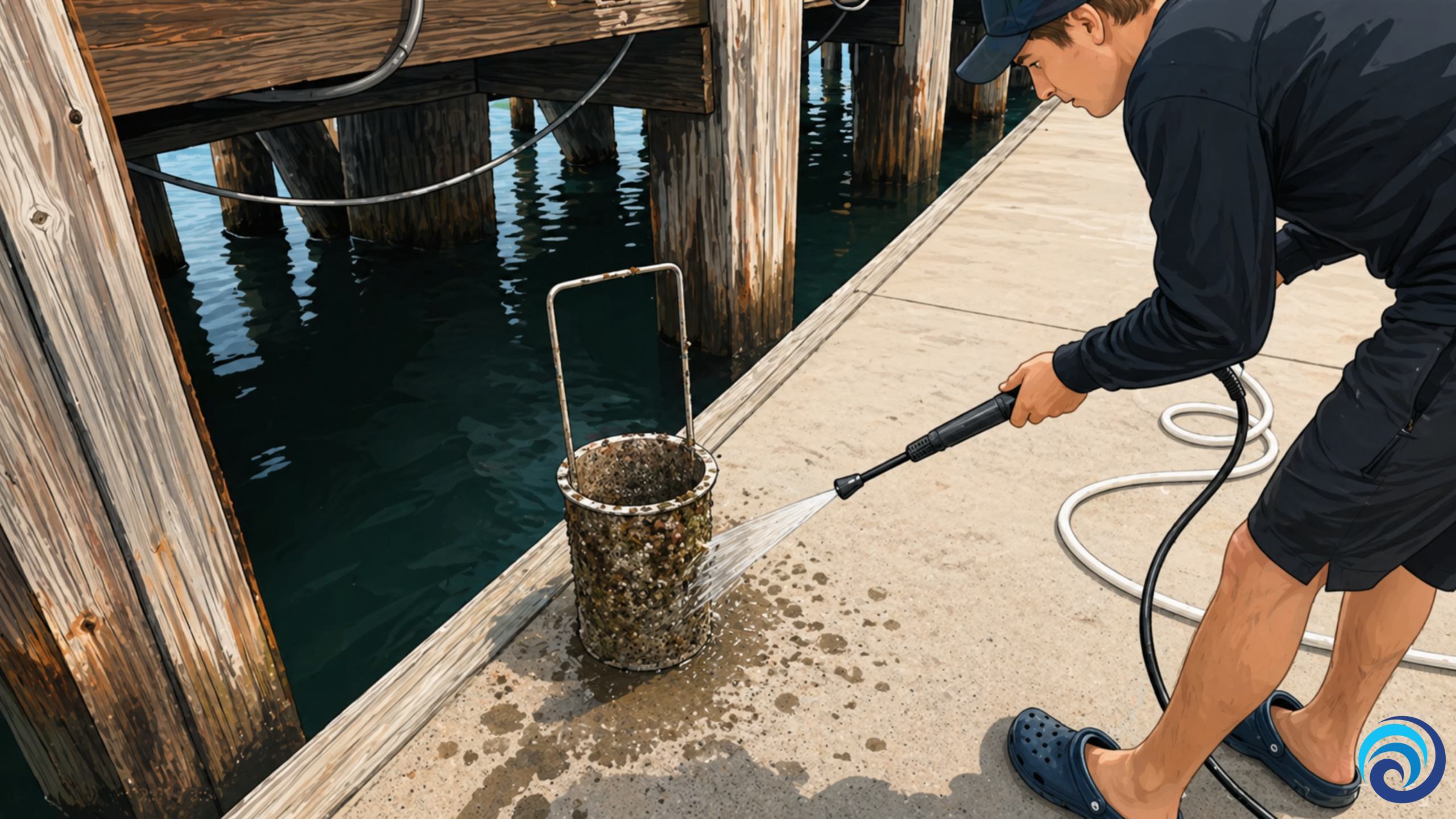
Cleaning your boat’s raw water strainer sounds simple. On paper, it’s straightforward enough. Remove a small component, clean it, and pop it back in.
But in practice, strainer cleaning is often messy, awkward, and repetitive. And if you boat in warm water, strainer maintenance becomes a regular weekly chore.
Whether you’re dealing with A/C failures, strainers clogging every week, or an engine strainer you forgot to check (until temps started creeping up), here’s how to clean your strainer. We’ll cover what to expect with boat strainer maintenance and how to make it less time-consuming.
What a strainer does (and why it matters)
A marine raw water strainer is your boat’s first line of defense in protecting the air conditioning from clogged lines and heat-sweltering failure.
The strainer filters debris such as seaweed, plastic, minnows, and barnacles from seawater before it reaches critical boat systems, including:
- Air conditioning (most susceptible to clogged strainer failure)
- Engine cooling
- Generator cooling
- Live wells and washdowns
Step-by-step: How to clean a boat strainer
This is the real-world version—not the pretty manual version.
1. Turn off the system
Shut down anything pulling in water:
- A/C pump
- Engine (if applicable)
- Generator
You do not want suction or flow while opening the system.
2. Close the seacock(s)
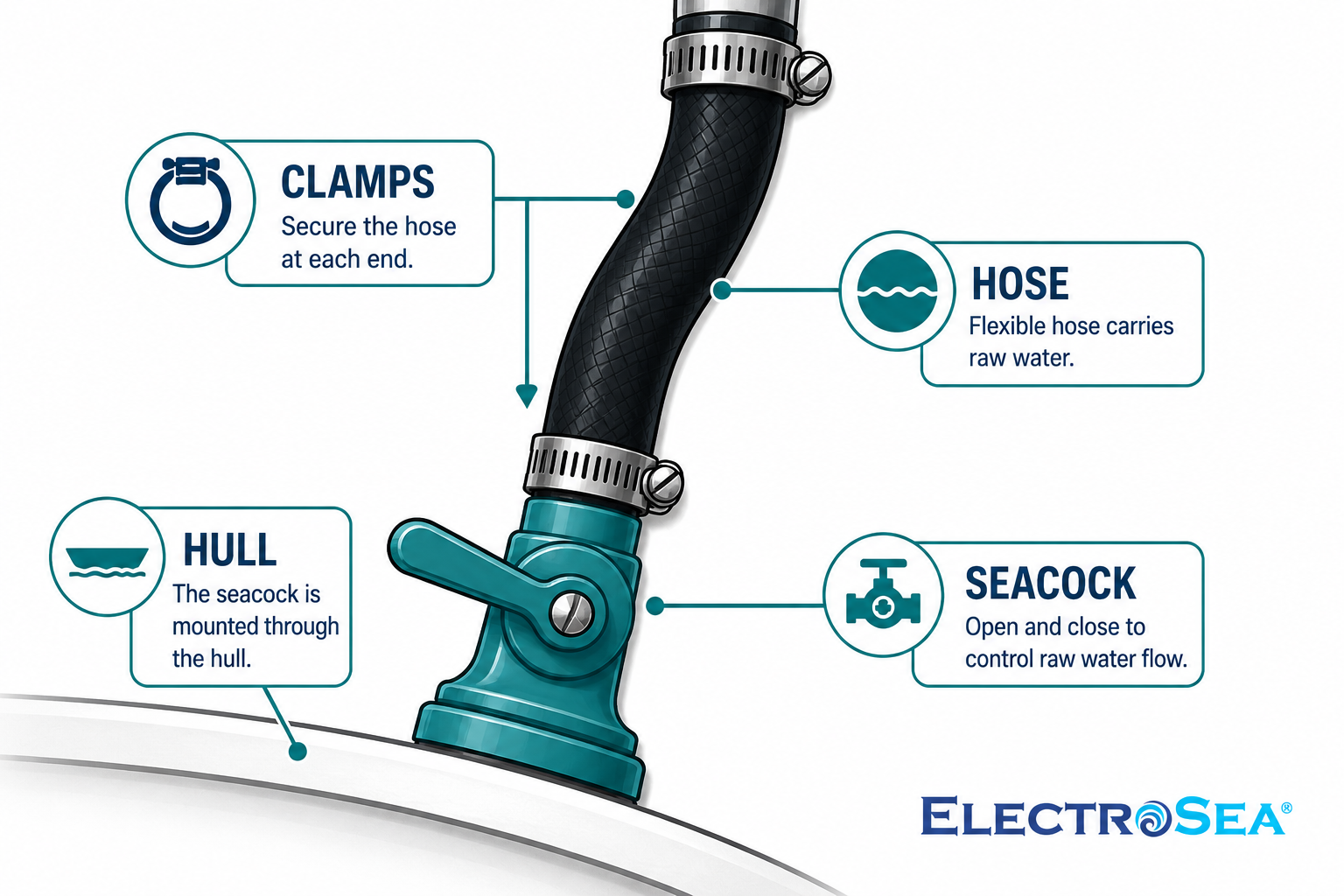
This is a critical step.
Setups vary across boats, but most have two seacocks: one inlet seacock and one outlet seacock.
If you skip this step, you will flood your boat.
3. Open the strainer housing
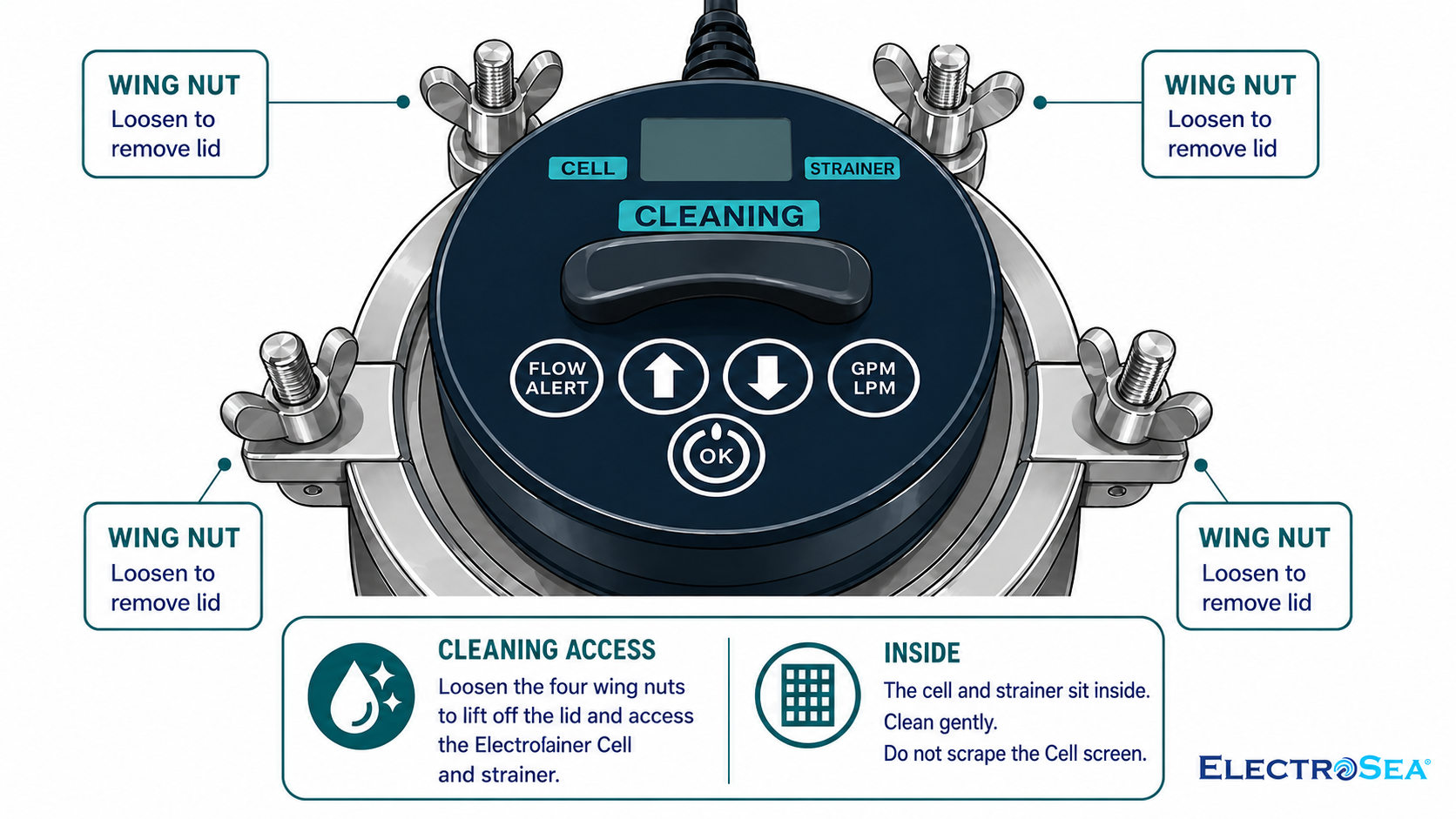
This step can take some elbow grease.
- Remove wing nuts or screws
- Break the seal on the lid
- Expect resistance (vacuum seal + growth buildup)
- Expect water to spill
If it feels stuck, it probably is. Marine growth can literally seal the lid shut over time.
4. Remove the basket (and whatever’s living in it)
Inside, you’ll usually find seaweed, sludge, shell fragments, barnacles, and the occasional “how did that even get in here?” item, like plastic Walmart bags.
Pull the basket out and inspect it.
If you can’t see through the strainer canister or housing before you pull out the sea basket, you already know that it’s clogged.
5. Clean the basket
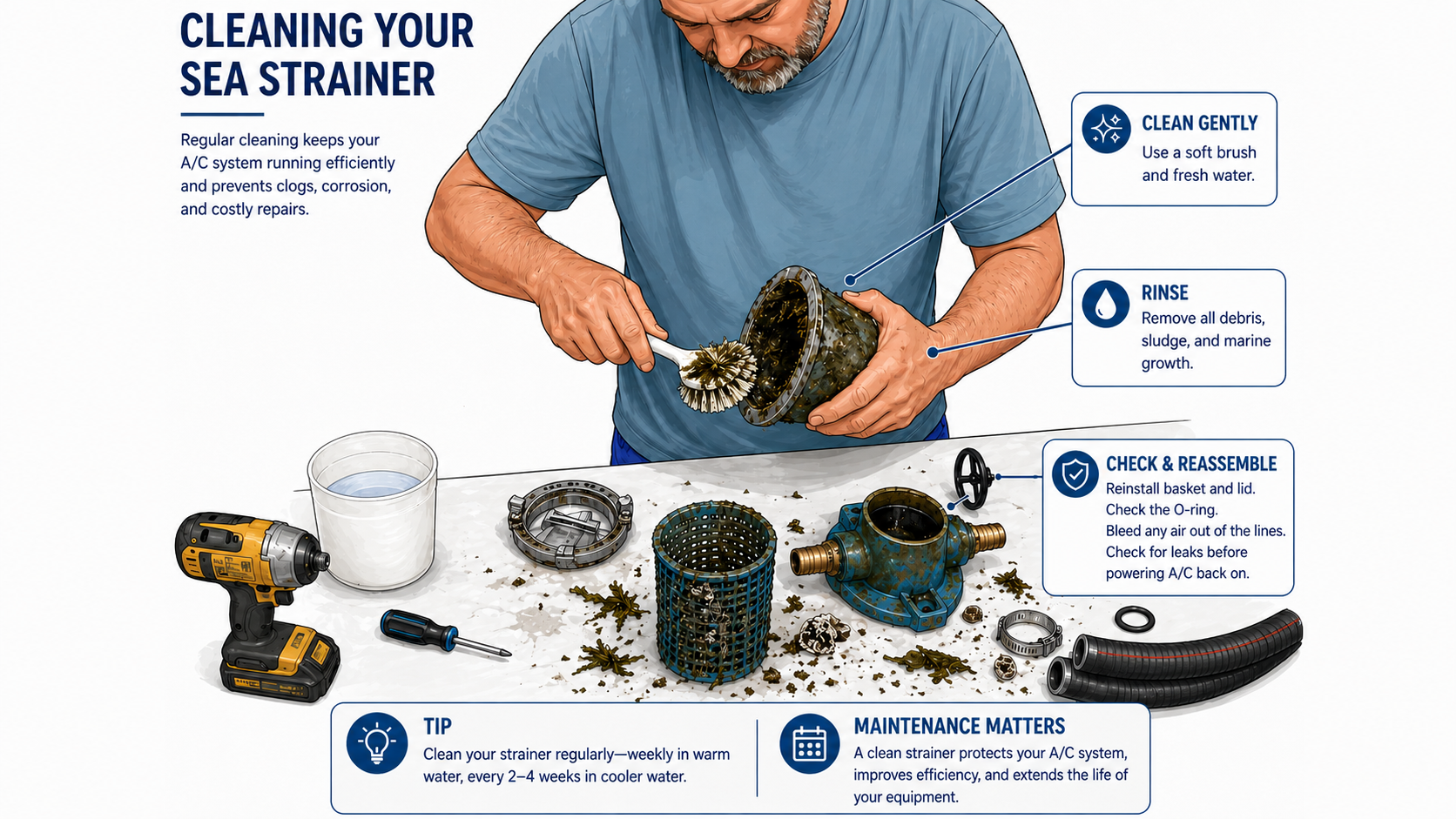
For standard strainers:
- Scrub with a brush
- Rinse thoroughly
- Soak or needed (boaters commonly use vinegar, bleach, or other descaling agents)
- Remove anything embedded in the mesh
Some people use toothbrushes, bottle brushes, or compressed air.
With the ElectroStrainer, no scrubbing is needed. Its antifouling technology means marine growth cannot survive in the strainer. Cleaning it requires rinsing the basket and cell screen with tap water – no scraping, descaling, or acids needed.
>> Get your ElectroStrainer quote today and enjoy stress-free strainer maintenance. Boaters everywhere call ElectroStrainer “a game-changer” and the “best money ever spent on the boat.” Get my free quote now.
6. Clean the housing
The inside of the strainer canister matters just as much as the basket.
At this step, you must scrub the walls and remove slime or barnacle buildup. On boater forums, owners recommend using a synthetic brush (not wire) for best results.
If there’s growth in the basket and canister, there’s more growth that you can’t see in your system. This includes your lines, pumps, and A/C chillers.
7. Reassemble everything
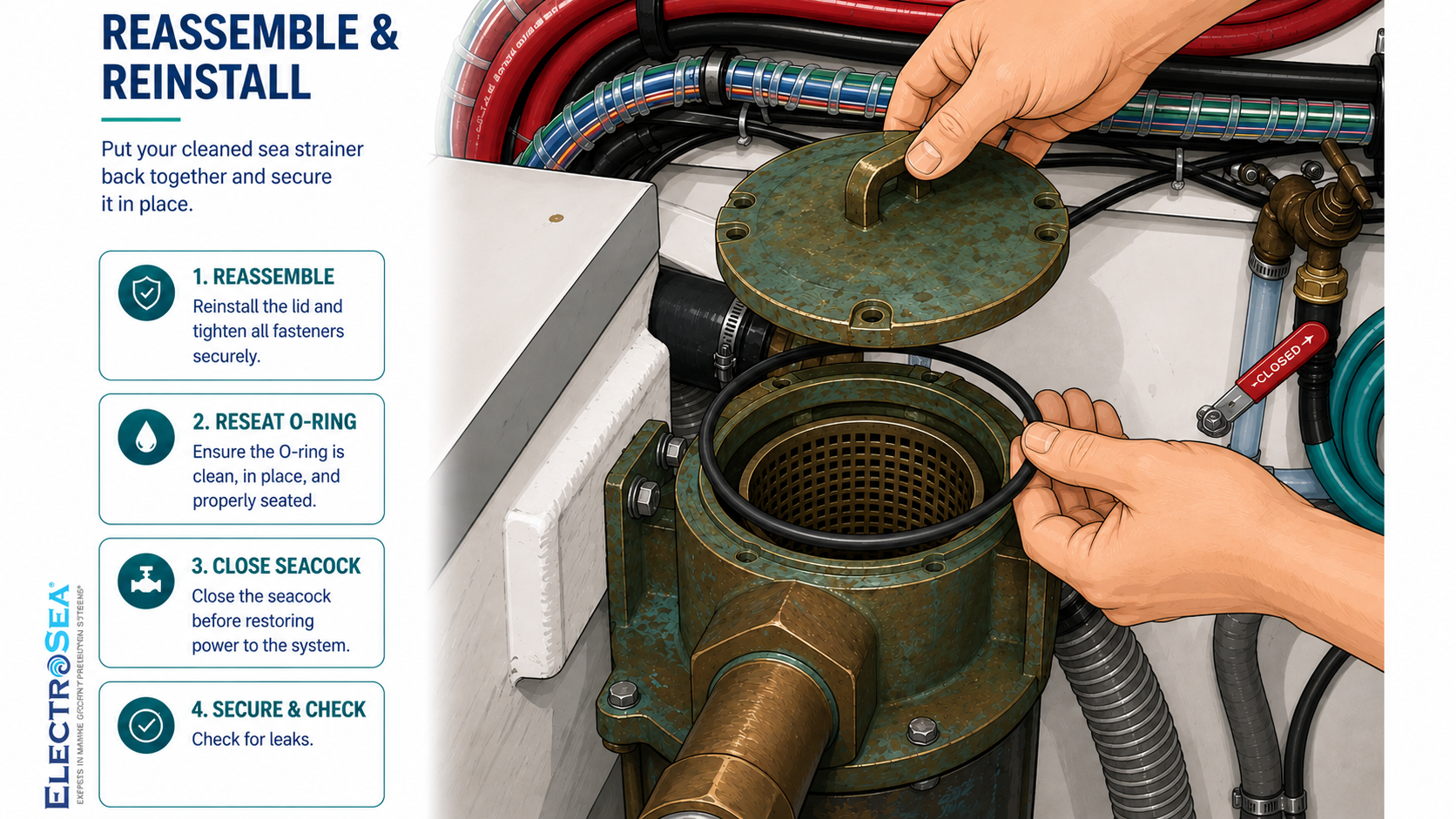
Seat the basket correctly. There’s usually an alignment notch to help you guide it back in place. Reinstall the O-ring or gasket, lubricating lightly if needed. Then tighten the screws and wing nuts evenly.
If it won’t close easily, something is not aligned. Don’t force it. Pull it out, re-align, and try again.
During reassembly, make sure to bleed any air out of the lines.
8. Reopen the seacock and test
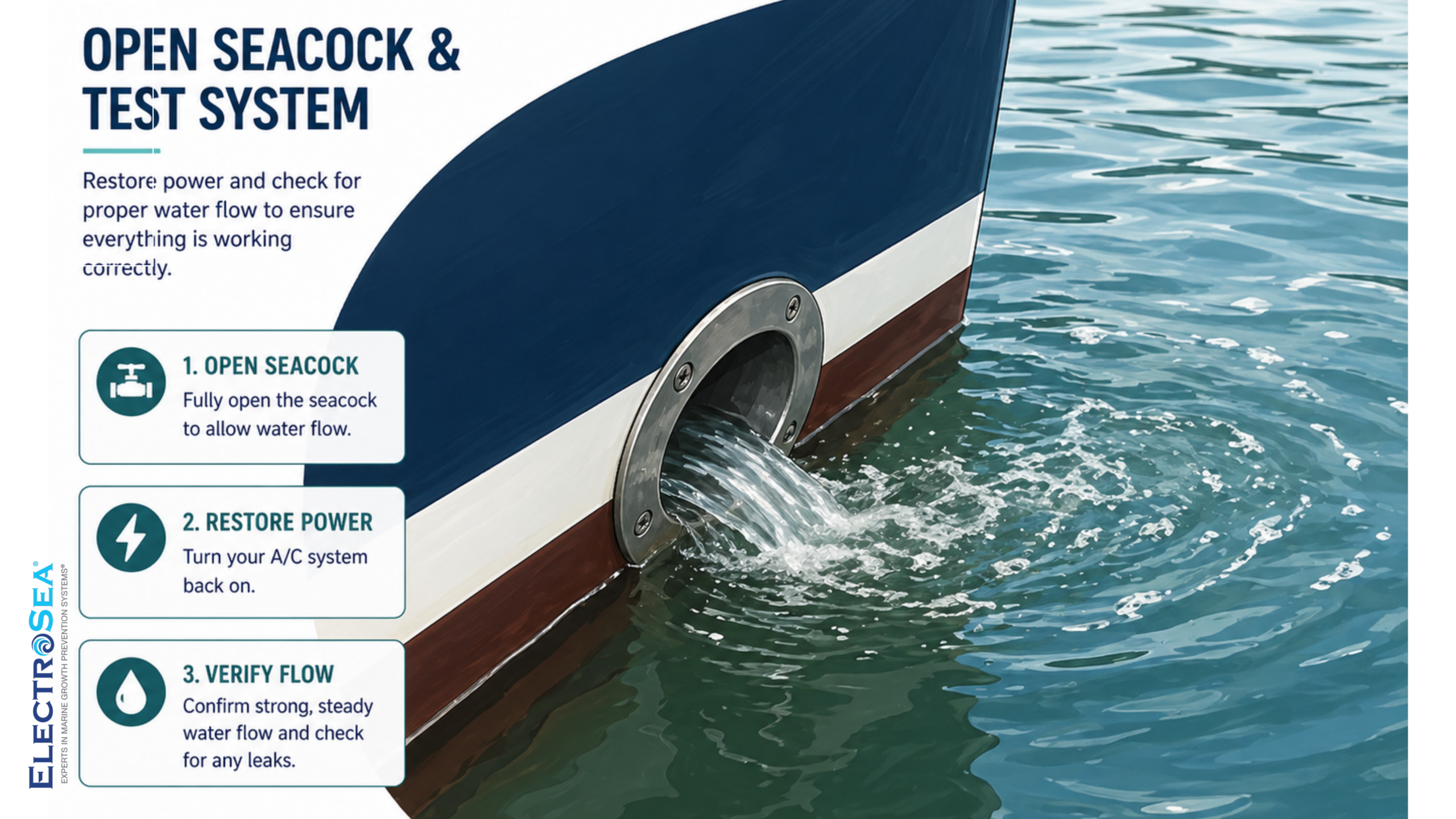
Test that everything is correctly resecured.
- Open the seacock
- Turn the system back on
Watch the reinstalled strainer carefully. You want to see water flowing freely with no leaks and minimal air bubbles. Air bubbles can indicate a bad seal, which could damage the impeller.
The struggle behind cleaning strainers
Talk to any boat owner (more specifically, any Florida-based boat owner), and you’ll quickly learn that cleaning strainers is a major headache.
Reaching the strainer can be uncomfortable and hot. Owners must often wedge themselves into tight spaces (sometimes upside down) to pull out a strainer that may be buried behind an engine, bilge, or under a bed in a guest stateroom.
After you reach the strainer, it’s generally wet, dirty, and pungent – it smells like the ocean’s garbage disposal. Then the strainer needs to be cleaned, descaled, and reassembled – on a hot boat with the A/C shut off.
While some boaters do this once or twice a year at most, many warm-weather boaters clean their strainers 2-3 times a month. Some must tackle this chore weekly.
Why A/C strainers require more maintenance than other boat strainers
If you’re constantly cleaning one strainer, it’s probably your A/C strainer.
Your air conditioning runs more often than other boat components, especially when docked. Marina waters have a low current, which means more marine life. Your A/C strainer sucks in everything drifting by.
How often do you clean your sea strainer?
It depends on where you keep your boat, how often you run the air conditioning, and what your sea strainer setup is.
If you boat in warm, stagnant waters (like Florida marinas), this is likely a weekly chore. For those who boat in colder waters, it may be a yearly or twice-yearly chore.
Boaters generally clean their strainer as often as needed to avoid overheating or poor A/C performance.
Some sea strainers, like the ElectroStrainer, are designed to be low maintenance. Many ElectroStrainer owners speak of cleaning their strainer every few months – or even just a couple times a year.
Tips to make strainer cleaning less miserable
Based on our boating experience and that of other seasoned boaters, here are some tips to make strainer cleaning less miserable.
- Keep a spare basket on hand. Swap the baskets now and clean later.
- Do a visual check first. Many strainers have clear housings. If you can’t see through it, it’s time for a cleaning.
- Don’t ignore early signs. Check your strainer when you notice reduced water flow, rising temps, or inconsistent A/C performance.
- Use caution with chemicals. Acid flushes (like descalers) can damage hoses and wear down system components. They clean the buildup but are harsh on the boat.
- Eliminate constant descaling and strainer maintenance. Strainers don’t prevent marine growth; they capture it. But marine growth prevention systems (MGPS) prevent marine growth at water intake by using electrochlorination. ElectroStrainer is a popular MGPS option, and the only one to prevent marine growth at water intake by using electrochlorination.
FAQs
How do I know my strainer is clogged?
There are many telltale signs that your strainer is clogged. If you can’t see through the strainer’s clear canister housing, your water flow rate drops, or your A/C is showing high-pressure or temperature errors, there’s likely an issue with a clogged strainer.
Why is there still buildup after I clean it?
Because the strainer isn’t the only place with growth. Growth doesn’t remain in the strainer basket alone; it spreads to lines, pumps, heat exchangers, and other components.
Can I clean it without closing the seacock?
No! That will flood your boat. Open seacocks let water onboard.
Why is my strainer so hard to open?
Difficulty opening your strainer is annoying, but common. The water inside builds up vacuum-like pressure. Additionally, growth inside (especially barnacles) may cause the O-ring to stick and seal the lid.
Is scrubbing enough, or do I need chemicals?
It depends on the severity of the buildup and your comfort level handling harsh chemicals.
For light debris, a rinse and scrub are often enough. Heavy scaling, calcium buildup, or marine growth may require an acid soak or full descaling treatment.
That said, aggressive cleaning chemicals come with risks. Repeated exposure to acids or bleach can damage hoses, seals, pumps, and A/C components over time.
Brielle Trupiano (Macchiarelli), ElectroSea’s sales manager, recently spoke with a boater who had been flushing bleach through his sea strainer monthly to control growth. It killed the marine buildup, but it also destroyed sections of his cooling system and A/C lines, resulting in a costly (six-figure) rebuild.
Chemical treatments are inherently corrosive. If you do pursue, proceed with caution.
Conclusion
Cleaning your strainer isn’t complicated, but for warm-water boaters, it is an annoying and relentless task. Knowing what to expect and having the right tools on hand can make the process go much more smoothly.
And while you’re tackling strainer cleaning, you can address other maintenance chores too, like descaling the AC unit, inspecting the raw water pump, clearing drain lines, and checking for hose leaks.
Ready to be done with harsh chemicals and scrubbing strainers? Contact ElectroSea today for a free, friendly quote. Bryan and Brielle respond to most inquiries within 24 hours.