
If you’ve owned a boat long enough, you’ve probably had to replace a seawater pump. Possibly many, many seawater pumps.
Pump failure is common. It can start with a leak around the shaft seal. Maybe it’s corrosion wear building up, or the pump overheating after running dry for a couple of minutes. Sometimes, it just quits – mid-season – leaving you scrambling to find a replacement (or waiting for months for a part that’s backordered overseas).
At ElectroSea, we’ve seen these scenarios play out.
After seeing how often pumps were breaking down on customer boats, we reached a simple conclusion: There had to be a better way.
That’s why we decided to build our own line of pumps, SeaStrong. ElectroSea released its first SeaStrong pump in 2022, quickly followed by the SeaStrong Silver Bullet in 2023 and the SeaStrong Silver Bullet RDP (Run-Dry Protection) in 2025.
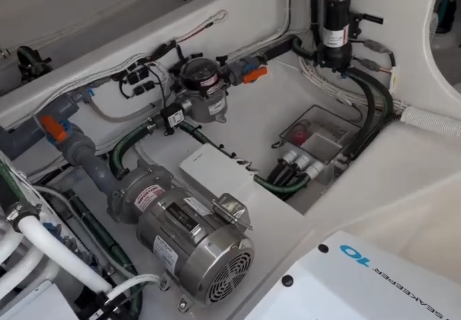
Why pumps fail
Marine pumps operate in difficult conditions. They move corrosive saltwater through hot, humid machinery spaces, supplying equipment such as air conditioners, chillers, and livewells.
Seawater pumps must also contend with changing vessel position, long plumbing runs, restricted intakes, marine growth, debris, and air entering the system.
These challenging conditions affect the pump’s input, which is critically important to its performance and its output.
NPSH (Net Positive Suction Head) drops
A centrifugal pump needs a steady supply of water at its inlet. Without water, a pump cannot operate and may overheat. Not only does your pump need to be supplied with water, that water needs to be at the right pressure. If the pump has to pull too hard to bring water in, it creates problems.
The amount of inlet pressure available to move water into the pump is described as net positive suction head available, or NPSHa. The pump itself has a minimum inlet requirement called net positive suction head required, or NPSHr.
When the available head falls below what the pump requires, the pressure at the pump inlet can drop low enough for vapor bubbles to form. Those bubbles collapse as they move into higher-pressure areas of the pump. This is cavitation, and over time it can cause noise, vibration, unstable flow, and damage to internal pump surfaces.
Several conditions aboard a boat can reduce NPSH (net positive suction head) available or otherwise interfere with water reaching the pump:
- A clogged thru-hull intake or sea strainer
- Marine growth inside the plumbing
- A suction hose that is too narrow, too long, or sharply bent
- Too many fittings or other restrictions before the pump
- Poor pump placement relative to the waterline
- Warm seawater; its higher vapor pressure means higher inlet pressure
- Air leaks at strainer lids, gaskets, hoses or fittings
Air leaks
Air entering the suction line is not the same as cavitation. It is usually called air entrainment; when air becomes mixed into the pumped liquid, the condition may also be called aeration. It can produce similar symptoms to cavitation, including noise, unstable flow, and loss of prime (where it fills with air instead of liquid).
Because a centrifugal pump is designed to move liquid, too much air can prevent it from supplying the flow that connected equipment needs.
Pump curve misalignment
The pump must also be properly matched to the plumbing system it’s supplying. Every centrifugal pump (a pump that spins water to move it) has a pump curve showing how the flow rate – how much water moves through the pump over time – changes under different conditions.
Water encounters resistance as it travels through a boat’s plumbing. Narrow or long hoses, vertical lift, bends, valves, strainers, and connected equipment can all make water harder to move. Marine growth, debris, and clogged strainers can add resistance over time.
A pump curve generally slopes downward: As resistance increases, the amount of water the pump can move decreases. The maximum flow rate advertised for a pump usually represents ideal conditions with little or no resistance. The pump may deliver much less flow once installed aboard a boat.
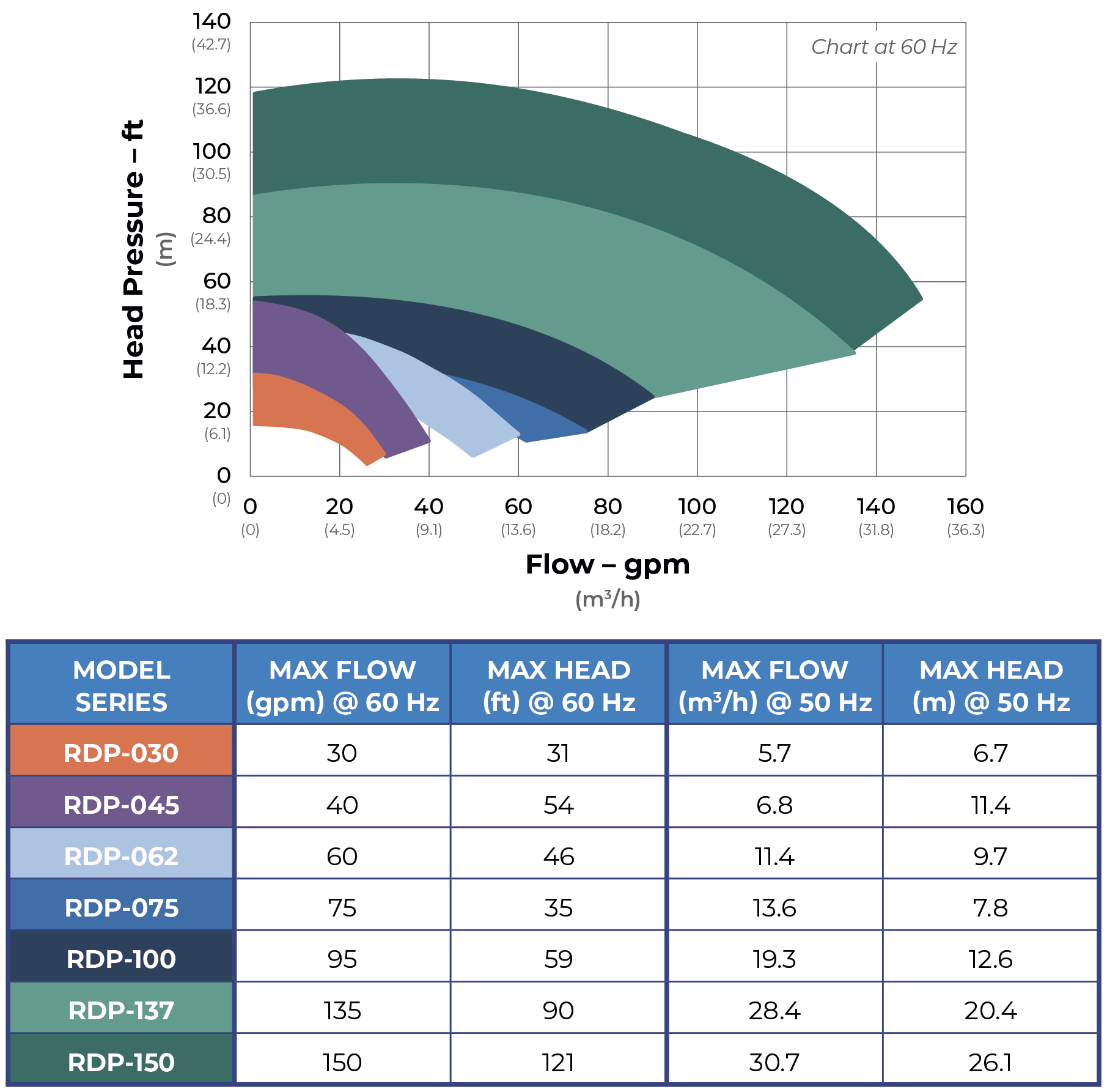
The horizontal axis of the pump curve shows the flow rate of the pump in gallons per minute (GPM) or cubic meters per hour (m3/hr). The vertical axis shows the pressure the pump is putting out, measured as “head” in units of feet (ft) or meters (m). Head is a convenient way to measure pressure in water-based pump systems; it is simply the pressure required to push water up a vertical pipe to a certain height.
The pump’s actual flow rate depends on what the pump can produce and how difficult the boat’s plumbing makes it to move water. If the two are not properly matched, the pump may deliver too little cooling water or operate outside its most reliable range, which can lead to premature equipment failure.
That is why choosing a marine pump requires understanding:
- Matching inlet and outlet sizes
- Comparing maximum flow in GPM (gallons per minute) or LPM (liters per minute)
- Pump curve – how flow and performance will be impacted as resistance increases
As resistance (like marine build-up) increases, flow decreases. A pump selected only for its maximum gallons per minute (GPM) can deliver considerably less water once it is connected to the boat’s actual hoses, fittings, strainers and equipment.
Operating outside a pump’s intended range
A pump curve shows more than how much water a pump can move. It also helps identify the range where the pump operates most efficiently and reliably.
Every centrifugal pump has a best efficiency point (BEP). BEP is the point where the pump operates most efficiently. Here, the pump turns the greatest share of motor power into water movement with minimal wasted power and minimal stress on internal parts, helping the pump last longer.
When a pump operates farther from its BEP, less of the motor’s power is used to move water where it needs to go. More energy is lost through heat, vibration, and turbulence, wasting electricity and increasing wear on the pump’s internal components.
Pumps do not have to operate at that exact best efficient point (BEP) all the time. However, they generally perform best and last longer when operating at a preferred range around it.
As an analogy, think of a pump’s BEP like a car operating at optimal conditions. For many models, a car cruising steadily at around 50 mph, with minimal braking or acceleration, is operating near peak efficiency.
That car can reach speeds of 120 mph. But driving at 120 mph for hours is going to put greater strain on the vehicle and increase the likelihood of premature failure. Generally, the closer you keep your car to its peak-efficiency range, the less energy it wastes, the less wear it experiences and the longer its components are likely to last.
For pumps, the same principle applies. A pump can operate outside that range in two directions:
- Too much flow: Too little resistance lets the pump move more water than it can handle efficiently, increasing power use, motor strain, and cavitation risk. It’s like spinning a car’s tires while the car is lifted off the ground.
- Too little flow: Too much resistance prevents enough water from moving through the pump, creating heat, vibration, and internal stress. It’s like pressing the gas while holding the brake: The engine works, but resistance limits movement.
Why pumps operate outside BEP (best efficiency point)
Pumps commonly operate outside of their BEP or preferred operating range.
Common reasons:
- Wrong pump size: Choosing a pump that is too large or too small for the system.
- Wrong hose size: Installing hoses that are too narrow or too long (excess length increases friction resistance as water rubs against the hose walls).
- Wrong hose-pump setup: Adding too many bends, valves or fittings, all of which increase the amount of resistance the water encounters.
- Pump is placed too high above the waterline: A convenient location is not always workable. The higher the pump sits, the farther the water must rise to reach it and the less water pressure is available at the pump inlet.
- Marine growth: Barnacles and other growth can accumulate inside thru-hulls, hoses and equipment, gradually narrowing the path and restricting water flow.
- A blocked or partially closed water path: A debris-filled sea strainer or partially closed valve creates a bottleneck that prevents enough water from reaching the pump.
The pump may continue running under any of these above conditions, but “running” does not necessarily mean operating correctly.
Over time, excess heat, vibration and uneven internal forces can reduce performance and shorten the life of bearings, seals, and other pump components.
Even a well-built pump can perform poorly if it is incorrectly sized, installed in the wrong location, or connected to plumbing that pushes it outside its intended operating range.
Saltwater accelerates pump wear
Even a correctly sized and installed pump must survive constant exposure to saltwater. Saltwater is hard on materials. It conducts electricity and speeds up corrosion, especially where different metals come into contact. Heat, humidity, vibration, marine organisms, and debris add further stress.
Saltwater can damage:
- Mechanical shaft seals: Salt deposits, debris, and corrosion can damage sealing surfaces and lead to leaks.
- Metal parts in the water path: Constant saltwater exposure can cause corrosion and erosion.
- Water-lubricated bearings: Debris and mineral buildup can increase friction and wear.
- Internal water passages: Marine growth can narrow passages and restrict flow.
- External hardware and motors: Salt spray and humid air can corrode exposed components.
General-purpose pumps don’t adapt well to marine environments
Some pumps used aboard boats were originally designed for general-purpose applications and later adapted for marine use. Even pumps sold specifically for marine systems vary widely in their materials, internal design and ability to tolerate real-world saltwater conditions.
Boaters, captains, and marine service professionals have told us about pumps failing within three to six months, sometimes with little or no warranty protection. These experiences shaped how we approached SeaStrong.
SeaStrong combines established pump technology with ElectroSea’s experience in real marine systems. The pumps are configured and built to reduce common failure points found in seawater applications, not simply to operate in ideal conditions.
How SeaStrong addresses common pump failure points
No pump can compensate for incorrect sizing, restricted plumbing or poor installation.
SeaStrong was designed to address failure points within the pump itself, including shaft-seal leaks, corrosion and damage caused by temporary water loss.
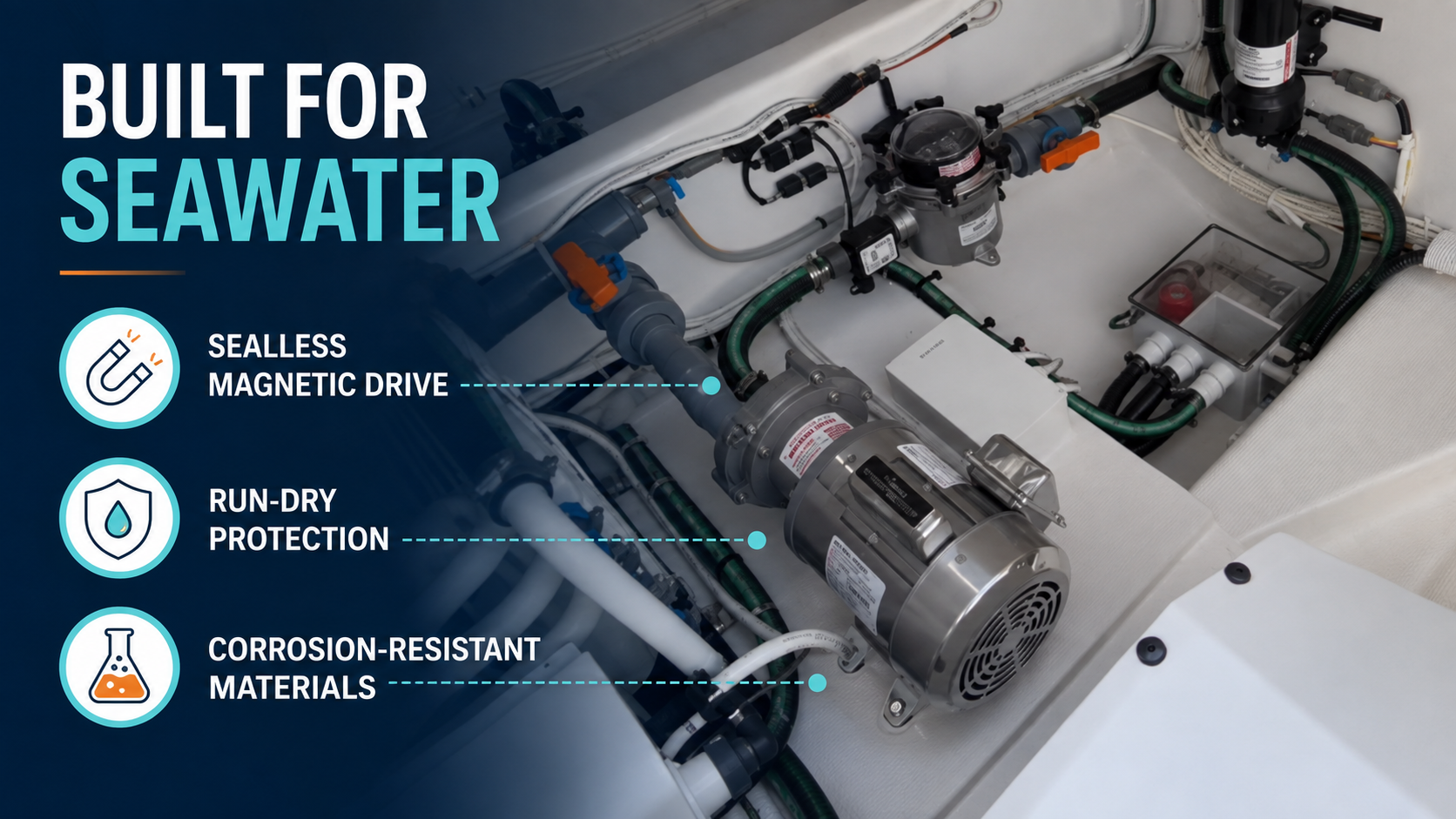
A sealless magnetic-drive design
Traditional direct-drive pumps have a rotating shaft (metal spinning rod) that passes from the motor into the pump. The shaft transfers power to the part that moves water through your plumbing system.
A mechanical seal closes the opening around the shaft. It has two faces, one spinning with the shaft and one stationary, separated by a microscopically thin film of water that keeps them lubricated and cool. Even a brand-new seal – by design – lets a tiny, imperceptible amount of that water escape. This microscopic amount is called the “weep.” With fresh water, the weep is harmless. With seawater, it can leave salt deposits that grind on the seal faces.
Over time, the constant spinning wears the seal faces, and the weep can grow into a true leak. Once that happens, water (fresh or saltwater) can reach the bearings, the motor or surrounding equipment.
To protect against leaks, SeaStrong Silver Bullet has no mechanical shaft seal. It uses a sealless magnetic-drive design. Magnets transfer power from the motor to the pump without a rotating shaft needing to pass through the pump housing (outer casing).
Materials selected for seawater exposure
Not every part of a seawater pump comes into contact with water. The parts that do must resist corrosion, erosion and marine growth.
SeaStrong Silver Bullet RDP has a glass-fiber-reinforced composite pump head with no metal components in the seawater flow path. This limits the metal surfaces directly exposed to saltwater.
Where metal provides needed strength outside the water path, SeaStrong uses corrosion-resistant 316L stainless steel. This includes the motor-to-pump connection plate, reinforced inlet ring, and other external hardware.
Run-dry protection during temporary water loss
Centrifugal pumps typically rely on the pumped water to cool and lubricate internal components. If water flow stops, friction generates heat that can damage the pump within minutes.
Flow can stop for several reasons:
- A plastic bag or other debris blocks the thru-hull intake
- Marine growth restricts the plumbing
- The sea strainer becomes clogged
- A valve or seacock is closed
- The pump loses prime
- Someone accidentally operates the pump without opening the water supply
SeaStrong Silver Bullet RDP was designed to tolerate these temporary run-dry events. Its patented Run-Dry Protection technology combines proprietary materials with an internal design that reduces friction and manages heat.
The pump provides up to 60 minutes of run-dry protection. This additional time is especially important in marine air-conditioning systems, which may continue operating for several minutes after seawater flow stops before a high-pressure fault (HPF) shuts them down. A conventional pump may sustain damage during that delay.
Run-dry protection (RDP) does not make water loss harmless or eliminate the need to correct the underlying problem, but it gives the pump a better chance of surviving the time between flow loss and system shutdown.
Installation-focused details
A pump must fit into the available machinery space without forcing installers to use an inefficient plumbing layout.
SeaStrong’s pump head rotates, allowing the inlet and outlet to be positioned for the installation. This can help reduce unnecessary hose length, sharp bends and extra fittings.
A 316L stainless-steel inlet ring is molded into the composite pump head. It reinforces an area that can be damaged by overtightening or stressed by connected plumbing.
The IP55-rated, totally enclosed fan-cooled (TEFC) motor is designed to limit the entry of dust and water. Its stainless-steel exterior also provides additional corrosion resistance in humid machinery spaces.
An internal flow path designed using CFD
Pump performance also depends on how water travels through the pump head. Areas with weak circulation can collect debris and give marine growth more opportunity to develop.
ElectroSea used computational fluid dynamics (CFD), computer modeling that shows how water moves through a closed system, to study the SeaStrong flow path. The pump head was shaped to reduce low-flow areas and internal spaces where water could stagnate.
This design cannot prevent growth elsewhere in the boat’s seawater system. However, maintaining stronger movement through the pump helps reduce internal buildup and support consistent flow.
Pump availability limits downtime
Pump reliability matters, but so does access to a replacement when a pump eventually needs service.
A failed seawater pump can disable air conditioning during the hottest part of the season. The pump itself may represent only part of the cost. Emergency service, delayed repairs, canceled boating plans, and weeks spent waiting for an unavailable replacement can cost more.
ElectroSea designs, assembles, and stocks SeaStrong Silver Bullet RDP pumps in Minnesota for immediate shipment, often on the same or next business day. For boat owners, captains, dealers and service technicians, replacement availability is part of practical pump reliability.
Conclusion
Marine pump reliability depends on more than maximum flow. Pump sizing, plumbing resistance, installation, saltwater exposure, and temporary water loss all affect performance and service life. SeaStrong marine pumps address common failure points with seawater-resistant materials, sealless design, and models providing up to 60 minutes of run-dry protection.
A seawater pump rarely fails at a convenient time. Request your free SeaStrong quote today and get help selecting the right pump for your boat and plumbing system.
Common FAQs
What size pump do I need?
The right pump size depends on the flow your equipment requires, and the resistance created by the complete plumbing system.
Hose diameter and length, vertical lift, fittings, strainers, and connected equipment all affect actual flow. Inlet and outlet size and maximum GPM matter, but they do not tell the whole story; the pump curve shows how a model is expected to perform under real system resistance.
SeaStrong Silver Bullet RDP is available across seven series, with maximum flow rates from 28 to 150 GPM and connection sizes from 1 to 2 inches.
As a starting point, professional dealers can use the pump selection tool. Boaters and owner-operators can request a free SeaStrong quote. An ElectroSea rep can find the best fit for your marine plumbing setup.
How do I find the BEP (Best Efficiency Point) for my pump?
Check the pump manufacturer’s performance curve or technical data sheet. The best efficiency point may be marked as “BEP” or shown at the peak of an efficiency curve.
A basic pump curve showing only flow and head may not include enough information to identify the exact BEP. If it is not shown, ask the manufacturer for the pump’s BEP and preferred operating range. You will then need to compare that range with the pump’s actual operating point in your plumbing system.
How do I figure out my pump curve?
The pump manufacturer figures out your pump curve. Manufacturers test each model and publish its curve, so first find the curve for your exact pump, impeller size, voltage, and operating frequency.
To read it, find your system’s head (the total resistance the pump must overcome) on the vertical axis. Move across to the pump curve, then down to the horizontal axis to estimate the flow the pump will deliver under those conditions.
Determining system head may require accounting for vertical lift (height the pump must move water upward), hose length and diameter, fittings, valves, strainers, and connected equipment.
SeaStrong curves are available in the SeaStrong Pump Selection Guide. ElectroSea can also help match the correct curve and model to your boat’s system.
How quickly can you ship an ElectroSea SeaStrong pump?
Standard UPS ground shipping is 3 business days. For an added charge, UPS Next Day is available.